
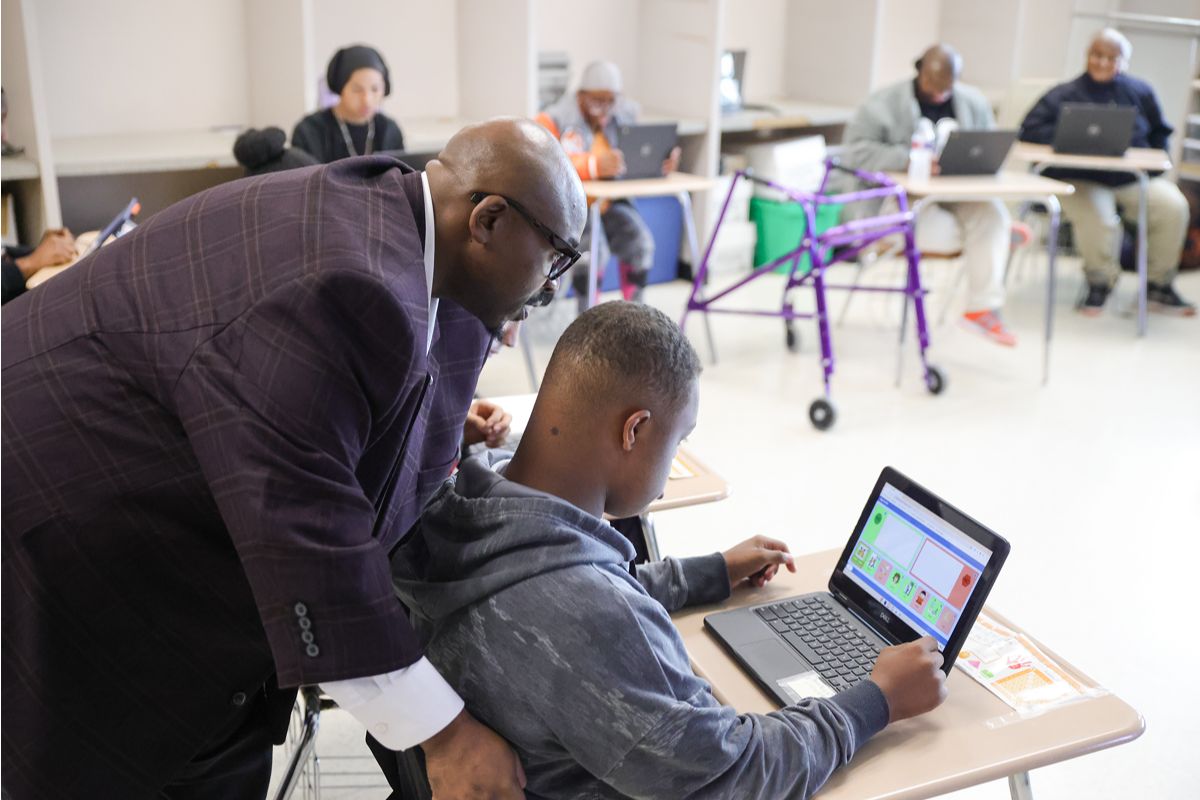
“I had one student with behavior issues who didn’t want to attend class. […] Now he’s the one running to the board,” recalled Mr. Carl Butler, a life skills teacher at Lancaster ISD.
It’s a dream scenario for any educator. Students jumping out of their seats to participate in class.
So, what can help make transformations like that possible?
At Lancaster ISD, it started with a district-wide commitment to giving every student meaningful access to the general education curriculum. The changes that followed didn’t just impact what students were learning. They changed how students engaged in learning and how educators were able to support them.
Access Without Lowering Expectations
Every district wants students to have access to the same learning opportunities. Different ability levels, backgrounds, and needs shouldn’t stand in the way.
There are numerous ways to make learning accessible to students: adapting their environment, differentiating instruction, providing alternative ways to engage with content. A lesson that resonates for one student may not make sense for another. A classroom filled with peers may be welcoming to some students, but overwhelming to others.
Accessibility is about recognizing those differences and removing the barriers that stand between a student and learning. Educators have the important job of figuring out what each student needs and adjusting accordingly – a responsibility that often requires more time, resources, and work behind the scenes.
Lancaster ISD’s Special Education department was no stranger to that behind-the-scenes work. The district was committed to ensuring every student had access to the general education curriculum, which often meant educators had to:
- Piece together homegrown materials
- Make their own lesson plans
- Rework general education lessons
“We needed something structured. Something aligned. Something that lets our teachers support students and give them the same access without lowering expectations.” – Crystal Cromer, Executive Director of Special Education, Lancaster ISD
When Educators Get Time Back, Students Get More of It
Lancaster ISD’s goal was to make that work more manageable for educators. The district took a big step in that direction in 2013 by adopting Vizzle, RethinkEd’s Special Education Curriculum.
For educators like Mr. Butler, one of the biggest changes was time. “Vizzle has allowed us to free up our time to be able to pour into our students more.”
More time with students meant more opportunities to focus on what each student needed to succeed.
Clear, accessible lessons, intentional platform design, and interactive features helped bring learning to life. Frustrations and hesitations turned into confidence and growth.
The student who went from avoiding class to running to the board is just one example of that growth. Across Lancaster ISD, educators have seen how Vizzle helps keep students engaged and eager to learn. In just four months, students completed more than 20,000 lessons.
There’s More to the Story
Saving educator time and increasing student confidence are just two pieces of the district’s story.
Vizzle has also helped strengthen student progress monitoring, improve learning at home, create more consistency across classrooms and campuses, and increase the ability to differentiate instruction.
Read Lancaster ISD’s full story, Confidence that Grows with Them: Supporting Every Child and Every Educator with Vizzle, to explore the changes they made and what your district can learn from their experience.